
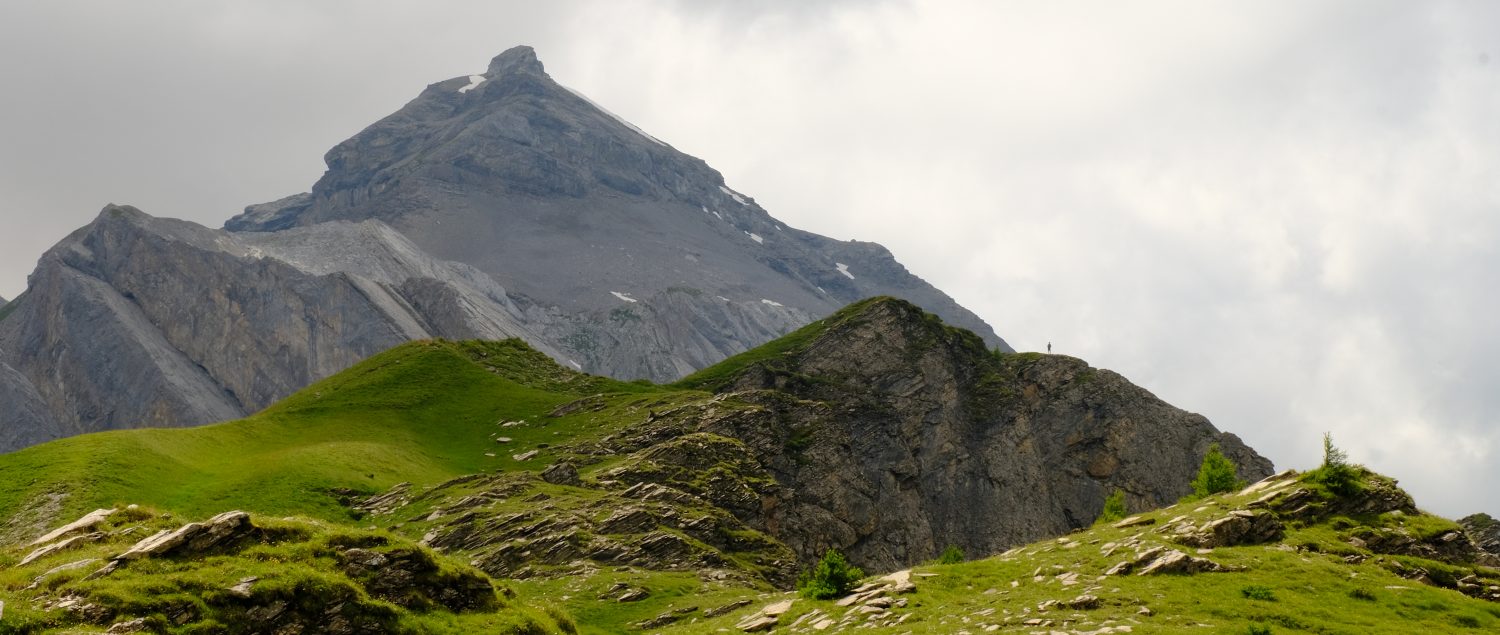

This final section of the Alta Via 2 leaves the savage beauty of the Pale di San Martino, crosses a mountain pass popular with expert cross-country skiers and then enters the less visited, florally abundant Parco Nazionale delle Dolomiti Bellunesi. The technical terrain and strenuous demands continue all the way to the final rifugio.
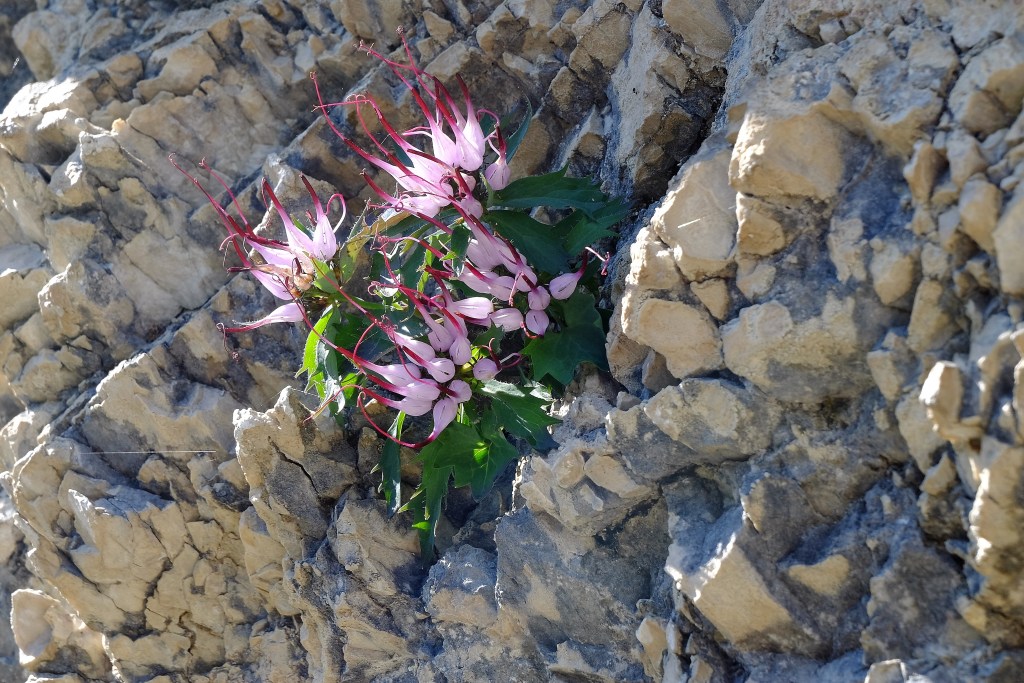
Photo Credit: Nick Haine
These notes are from the trip I organised and undertook with friends in July 2025. I used the Alta Via 2 – Trekking in the Dolomites guidebook (5th edition 2022), written by Gillian Price, published by Cicerone to plan and execute the trip and also took the relevant hardcopy Tabacco maps. Unless otherwise stated we followed the official AV2 route as described in the book and marked on the maps. For each stage I have noted the CAI (Club Alpino Italiano) hiking trail grade for the most technical part of that day (See the CAI Path Grades below (my translation from Italian)).
Please note the Dolomites Alta Via 2 is not merely a long distance hiking trail. Over half the stages pass through areas described by the Club Alpino Italiano (CAI) as rough and / or treacherous terrain only suitable for expert hikers. Don’t expect to be able to detour around these difficulties once you have started the stage. In addition to the usual multiday trekking equipment you will each need to take a harness, Via Ferrata kit, helmet, gloves and microspikes (or crampons and an ice axe if there is late lying snow). You need the skills to use this equipment, to move through steep, loose, unprotected and potentially snowy terrain with confidence and to make appropriate decisions depending on the weather and yourself / your group. Be aware that sometimes you will need to cross 30-45 degree slopes above sheer cliffs on narrow paths or scree and there will be no fixed cables for protection, a slip could easily be fatal.
Day 11: Rifugio Treviso to Passo Cereda (8.5km, 750m ascent, 1010m descent) Maximum CAI Path Grade E
Today scree moonscapes are exchanged for steep green slopes studded with juniper, bilberry and edelweiss as the trek leaves the Pale di San Martino and drops down to a pass used by expert cross-country skiers.
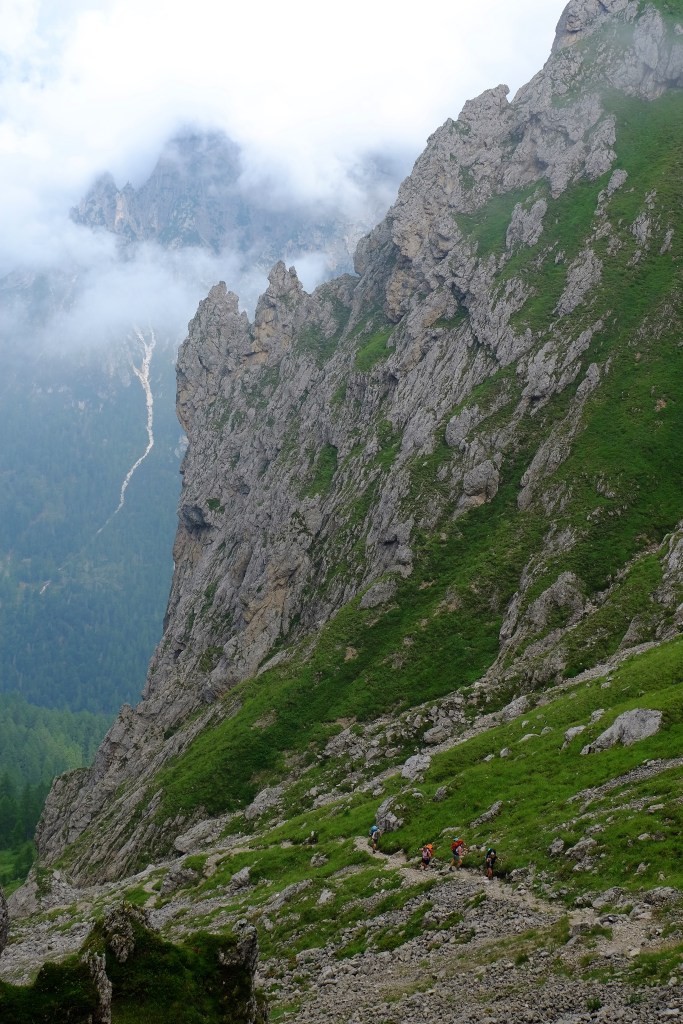
Photo Credit: Nick Haine
The CAI Path Grade E is accurate in that the route is well marked and maintained but, particularly after Forcella d’Oltro, the paths are very narrow and, should you step off them, a slippery grass slope is the only buffer between you and a vertical cliff edge.
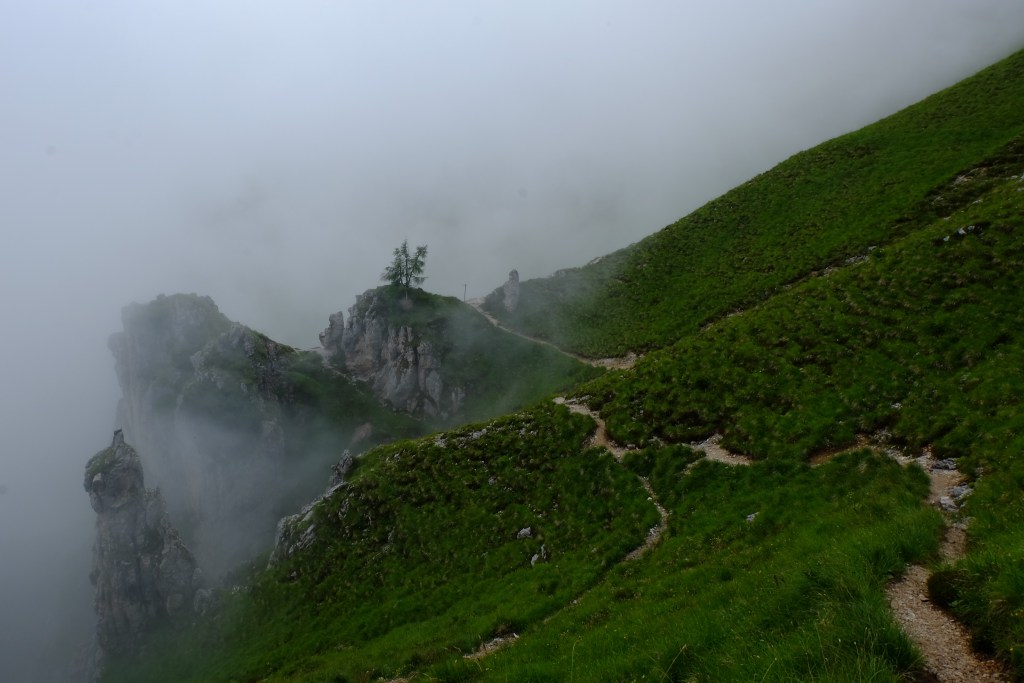
Photo Credit: Nick Haine
This section of the walk was much quieter with the little sound there was muffled by the mist.
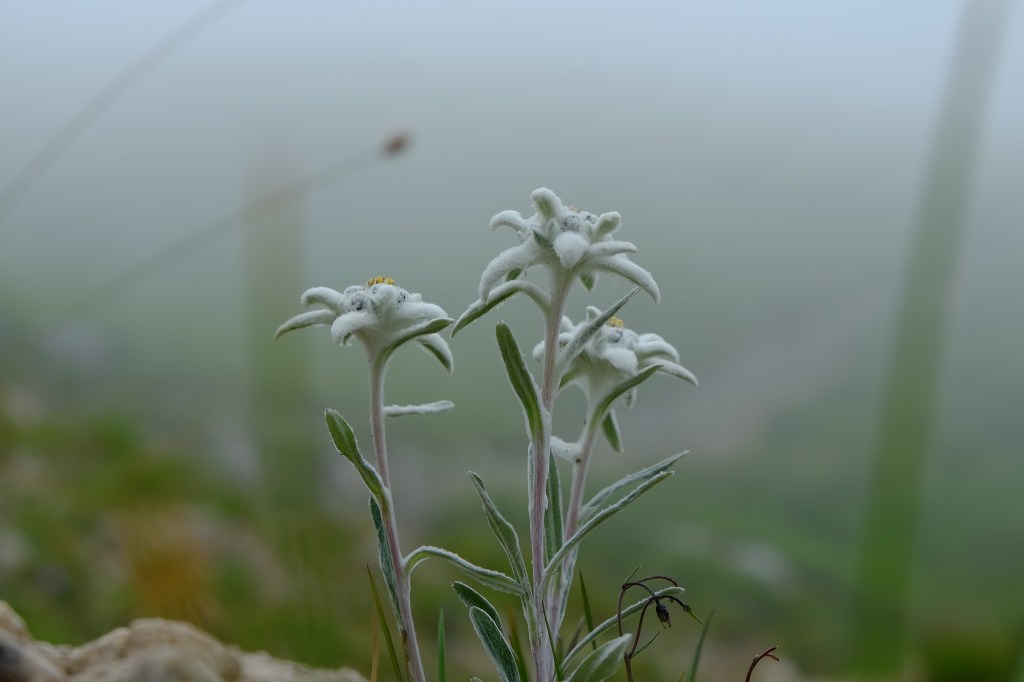
Photo Credit: Nick Haine
Escape Routes
It is very easy to follow Path 707 from Rifugio Treviso, steeply at first, down into Val Canali then either catch a bus from just below the Restaurant La Ritonda or pick up the straightforward Path 738 that swings round at a lower altitude to Passo Cereda. Maximum CAI Path Grade E.
Day 12: Passo Cereda to Rifugio Boz (13.5km, 1250m ascent, 900m descent) Maximum CAI Path Grade EEA
Another demanding day both technically and physically with some of the most nerve jangling unprotected rock / scree crossings of the whole Alta Via 2. The reward for this is an escape from the crowds and the incredible diversity of flora within the Parco Nazionale delle Dolomiti Bellunesi, the spectacular location for the last days of the trek.

Photo Credit: Nick Haine

Photo Credit: Nick Haine

Photo Credit: Sally Woodbridge
Escape Routes
As before, it is much better to decide right from the start to choose an alternative route rather than to become embroiled in serious terrain attempting an equally sketchy route off. An alternative here is to take a taxi round to Rifugio Fonteghi in Val Noana and walk up to Rifugio Boz (Maximum CAI Path Grade E).
Day 13: Rifugio Boz to Rifugio Dal Piaz (14km, 940m ascent, 670m descent) Maximum CAI Path Grade EE
The serious nature of the Alta Via 2 continues all the way to the final rifugio, once again this is a long strenuous day with difficult unprotected terrain. The only reason this section is graded EE not EEA is because no cables have been installed.

Photo Credit: Nick Haine
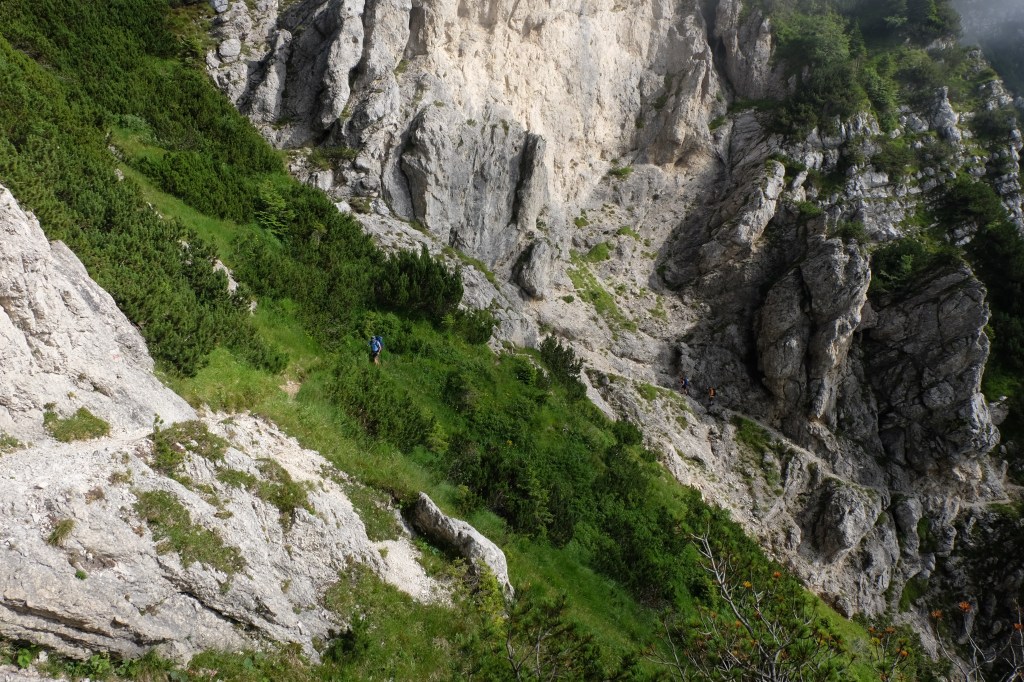
Photo Credit: Nick Haine
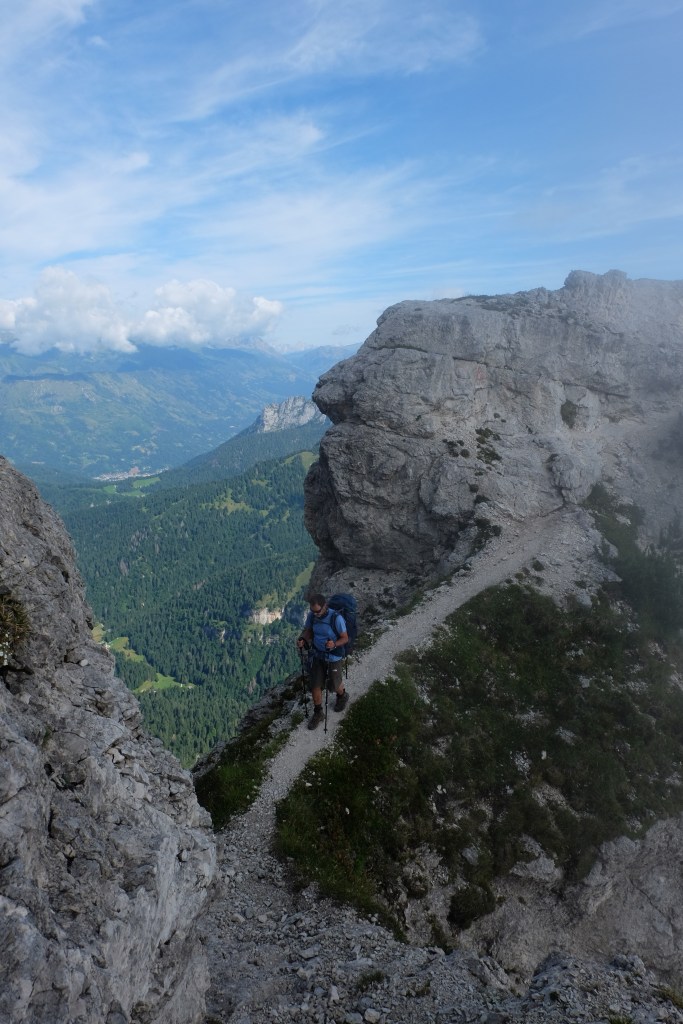
Photo Credit: Nick Haine
Escape Routes
From Rifugio Boz a long, flower-filled walk takes you down to Rifugio Fonteghi, across Torrente Noana, over alpine pastures and down to Mezzano in the valley, where there is accommodation and buses.
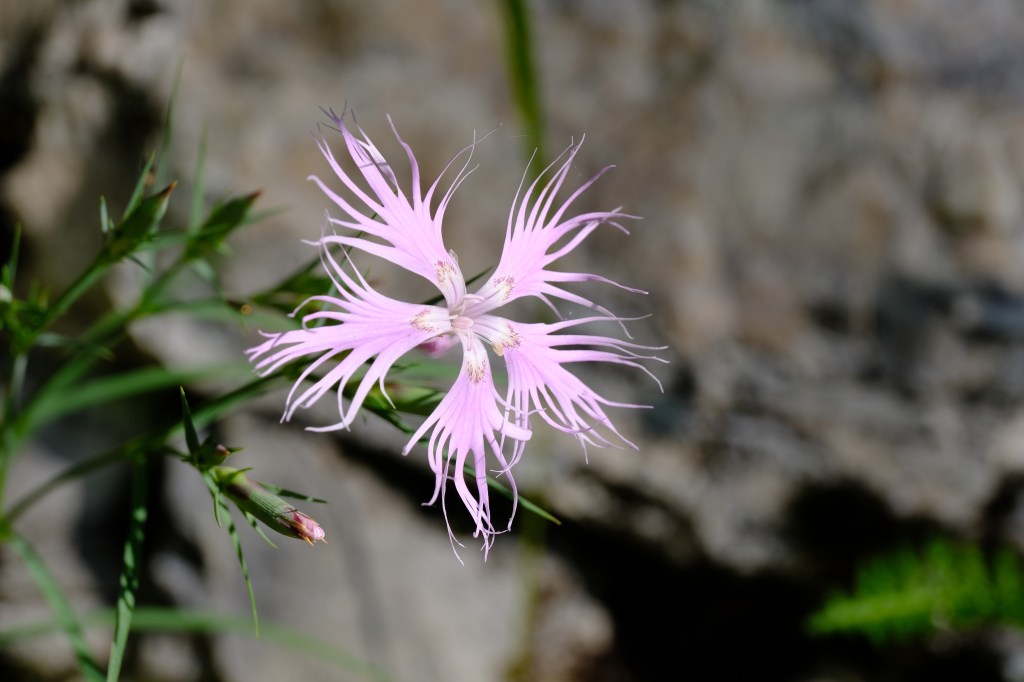
Photo Credit: Sally Woodbridge
Day 14: Rifugio Dal Piaz to Passo Croce D’Aune (5km, minimal ascent, 980m descent) Maximum CAI Path Grade E
I’m sure many would choose to skip a night at Rifugio dal Piaz and descend to the roadhead. However it is a long steep descent and another night in the mountains is never wasted in my book. I also decided to omit the long road walk into Feltre. An early bus from Passo Croce d’Aune allowed for an exploration of Feltre’s historic centre. Be aware that the buses into the valley from Passo Croce d’Aune are infrequent.

Photo Credit: Nick Haine
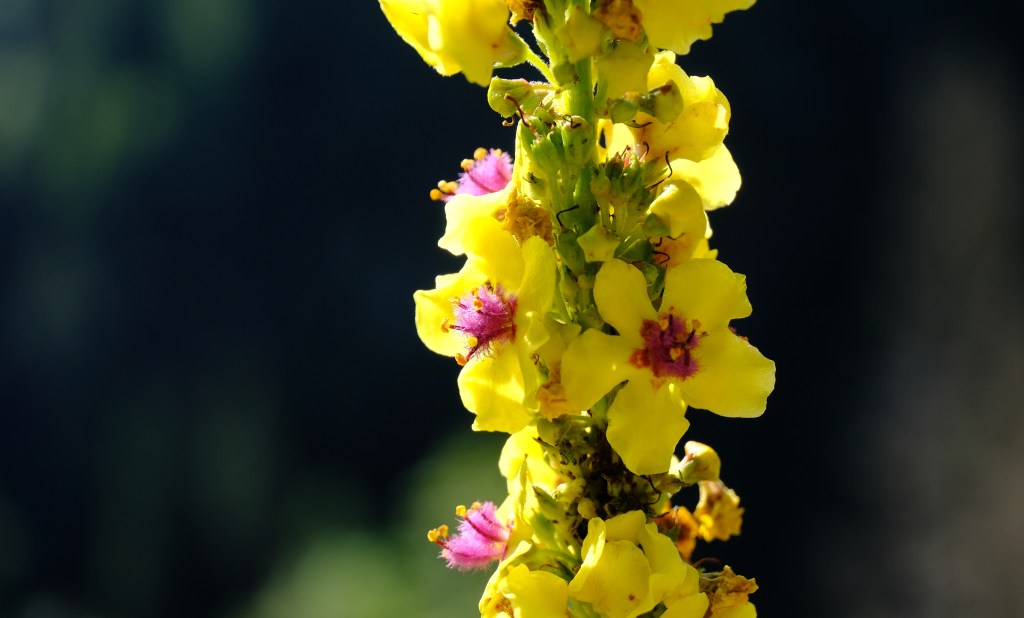
Photo Credit: Sally Woodbridge
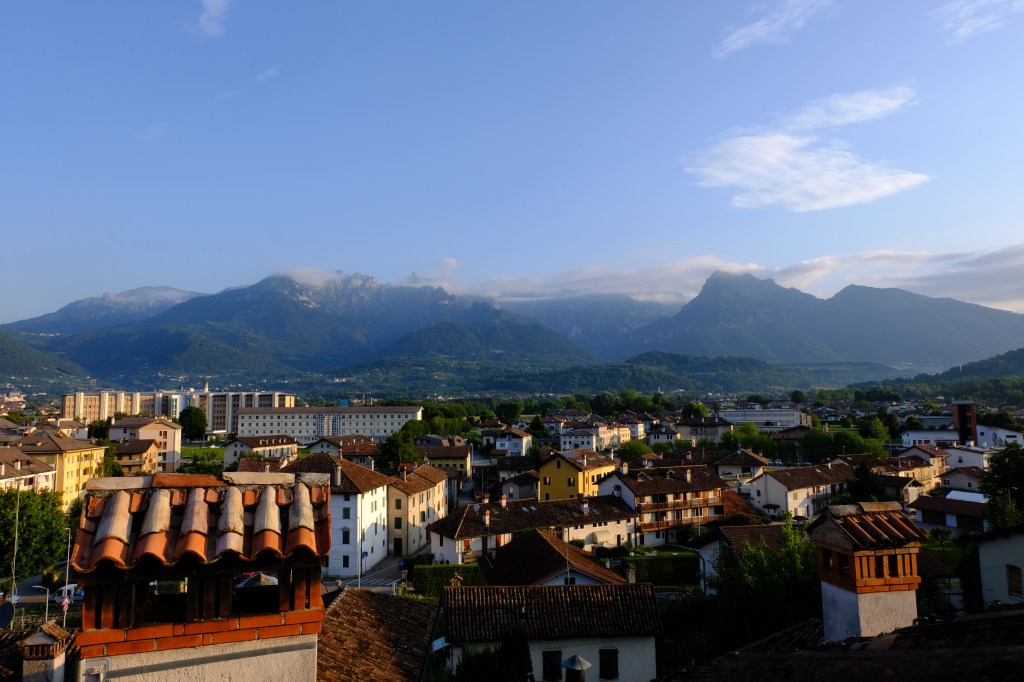
Photo Credit: Sally Woodbridge
The Dolomites Alta Via 2 is truly one of the most outstanding multi-day treks in existence. It weaves around or through four of the nine separate component areas of the Dolomites and provides stunning views into most of the others. Despite the challenges posed by the harsh environment there is a real commitment to maintaining the paths and providing welcoming accommodation at remote mountain rifugios or high mountain passes. In completing this trek you will draw on all your hard won alpine mountain knowledge, your skills of moving on steep, loose, exposed terrain, possibly in adverse weather conditions and reach deeply into your mental and physical endurance. As ever, the hardest undertakings are the most rewarding.
Look out for the next installment: Dolomites Alta Via 2: Planning a trip
CAI (Club Alpino Italiano) Path Grades
T (tourist) Marked on Tabacco maps with an unbroken red line
Small roads, mule tracks, or easy paths, with clearly marked routes that do not pose any uncertainties or orientation problems. They generally take place below 2,000 meters and usually provide access to mountain pastures or refuges. They require some knowledge of the mountain environment and physical preparation for walking.
E (Hiking) Marked on Tabacco maps with red dashes
These almost always take place on trails or paths over varied terrain (pastures, rough ground, scree), and are usually marked. There may be short, flat or slightly sloping sections of residual snow, where, in the event of a fall, a slide can be stopped quickly and safely. They sometimes cross open, pathless terrain, but are not technical, and always have adequate markings. They may cross steep slopes; exposed sections are generally protected with barriers or cables. They may include a non-exposed rock passage, or short, non-strenuous unchallenging sections with the use of fixed equipment (e.g. ladders, rungs, cables), which, however, do not require the use of specific equipment (harness, carabiners, etc.). They require a good sense of direction, as well as experience and knowledge of mountain terrain, walking experience, and appropriate footwear and equipment.
EE (Trails for Expert Hikers) Marked on Tabacco maps with red dots
These are trails that are usually marked but require the ability to navigate in technical terrain. Trails or tracks can be on rough and / or treacherous terrain (steep and/or slippery grass slopes, or mixed rock and grass, or rock and scree). There is varied terrain at relatively high altitudes (above 2000m) e.g. scree slopes, short, gentle snowfields, open slopes without landmarks, etc. There are rocky sections with slight technical difficulties, i.e. trails with fixed equipment (e.g. ladders, rungs, cables) or less demanding via ferratas. Trails on glaciers are excluded, even if they are flat and/or appear crevasse-free (because crossing them would require the use of a rope and ice axe and knowledge of the relevant belaying techniques). Requirements are general mountain experience and a good knowledge of the Alpine environment; sure-footedness and a head for heights; adequate equipment, gear, and physical preparation.
EEA (Trails for Expert Hikers with Equipment) Marked on Tabacco maps with red crosses
These are trails with fixed equipment (e.g. ladders, rungs, cables) or via ferratas requiring the use of self-belay devices (harness, shock absorber, carabiners, lanyards) and personal protective equipment (helmet, gloves).
https://www.cairovigo.it/classificazione-sentieri-cai/
Please remember that outdoor activities like walking come with inherent risks. The author has endeavoured to make the information as accurate as possible at the time of writing but the decision to undertake the walk is entirely at your own risk. No responsibility can be accepted for any kind of physical injury, loss or damage to you or your property.
If you enjoyed this please enter your email address below to follow this blog and receive notifications of new posts by email.
 SallyW Outdoor Adventures